01 / MEASURE
Deterministic measurement
Fixed-rule extractors measure defined features and check listed phrases and patterns. With the same input and pinned rules and runtime, the measurement is reproducible.
An external approach to AI governance
With an auditable record.
Patent pendingBOS/BSE is an external control architecture that makes defined aspects of AI behavior measurable, auditable and deterministically correctable—without asking a model to police itself.
Model-agnostic by design. The same input, under pinned rules and runtime, yields the same auditable measurement—no model judgment in the measurement path.
From measurement to guarded correction, near-miss reporting and audit integrity: working components, preserved builds and reviewable evidence.
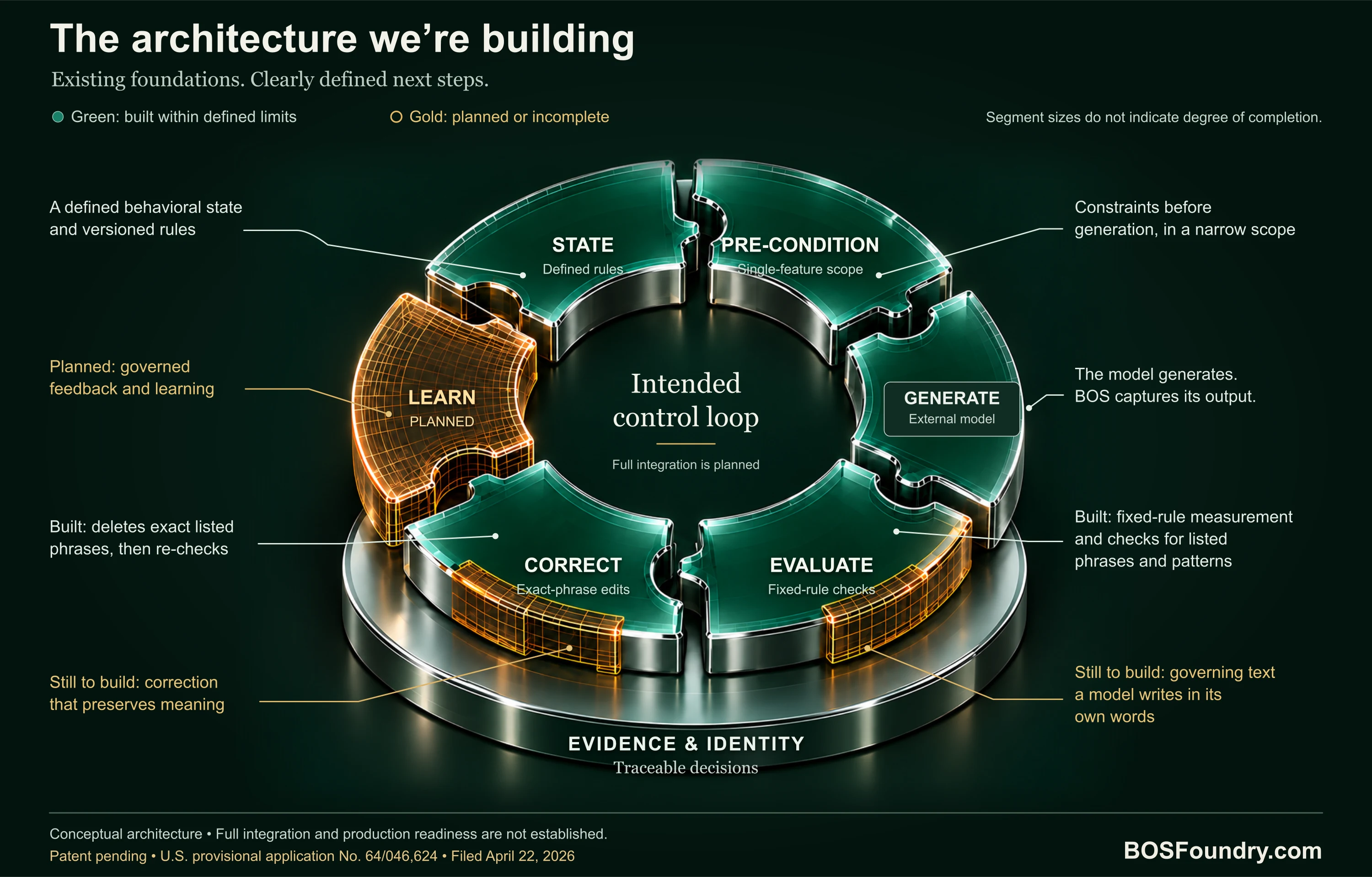
Segment sizes do not indicate degree of completion. Today’s checks cover listed phrases and patterns; correction deletes exact listed phrases and re-checks. Governing text a model writes in its own words, correction that preserves meaning, and the full learning loop remain to be built.
The problem
When evaluation depends on model judgment, it can inherit the same failure modes it is meant to detect. Re-prompting alone does not establish a reproducible correction or an auditable explanation.
BOS places behavioral measurement, disposition, correction and audit outside the model, where they can run on fixed, versioned rules. In the audit path we have built, the record is designed to be checked by a skeptical examiner.
The approach
The core of BOS: reproducible measurement, inspectable correction and evidence that survives scrutiny.
01 / MEASURE
Fixed-rule extractors measure defined features and check listed phrases and patterns. With the same input and pinned rules and runtime, the measurement is reproducible.
02 / CORRECT
Deterministic operators edit output directly, apply guards and re-check the result. Today’s exact-phrase correction is reproducible, inspectable and supported by its own evidence.
03 / PROVE
The built audit-integrity path records measurements and decisions in a tamper-evident, hash-chained, externally anchored record. Newer components preserve their own evidence as the architecture advances toward integration.
FROM THE RECORDS TO THE SCREEN
Explore five recorded cases: correction, restraint, uncertainty, and the limits still being researched.
The vision in practice
What a fully realized BOS could mean in everyday life and high-stakes work.
These illustrative scenarios describe the intended impact of the completed architecture, with the integrations and validation each setting requires. They are future applications, not customer deployments or measured outcomes.
You ask for a short answer. Twenty messages later, the AI has lost the objective, buried the answer in an essay, or turned a guess into something that sounds certain.
A finished BOS would aim to keep the assistant aligned with your defined task, boundaries and communication preferences—detecting drift, correcting eligible deviations, and surfacing uncertainty when it cannot establish a safe correction.
The payoffLess repetition. Less bloat. Less babysitting. More useful work.
A logistics assistant drafts a readiness briefing. Somewhere in the wording, “recommended for review” becomes “authorized to proceed.” The text has crossed a boundary the system was never empowered to cross.
In an appropriately integrated defense workflow, a completed BOS could flag the unauthorized claim, hold the affected output for review, and preserve the original response, governing rules and disposition. The responsible person retains the decision.
The payoffClearer authority. Traceable decisions. AI support that stays within its assigned role.
A customer-service AI explains a disputed charge, then says a refund has been approved—even though approval belongs to a separate process.
A completed BOS could govern that authority boundary, correct eligible wording or route the response for review, and leave a record of what the AI said and how it was handled. With the appropriate system connections, the workflow could distinguish an explanation, a recommendation and an actual authorized decision.
The payoffFewer unauthorized commitments and stronger evidence for investigating disputes.
A resident asks about a benefit or permit. The assistant moves from explaining the process to declaring the application approved. A helpful exchange has become an apparent official decision.
A finished BOS could keep the assistant within its defined service role, apply the agency's configured behavioral rules consistently, and route decisions requiring official authority to the responsible personnel—with a reviewable record.
The payoffMore dependable public-facing assistance and clearer accountability for consequential decisions.
An assistant preparing a visit summary turns a tentative clinical observation into a definitive conclusion, or moves from summarizing information to directing treatment.
With clinically validated rules and workflow integration, a completed BOS could help preserve uncertainty, enforce the assistant's assigned role, and flag identified departures for clinical review while retaining the original text and any permitted changes.
The payoffBetter support for clinicians, with clinical judgment and responsibility kept where they belong.
On hallucinations. Behavioral consistency is not proof of factual truth. The intended benefit is better control over unsupported certainty and out-of-role claims. Detecting factual errors also requires trustworthy reference information and task-specific validation; no claim of eliminating hallucinations is made.
Status of record · October 2026
BOS now has a growing foundation of reviewed, versioned components. Recent progress adds guarded correction, declared quote handling, near-miss reporting and stronger evidence verification.
Six-axis behavioral measurement in a controlled environment, using fixed rules for defined features.
A pre-generation constraint envelope demonstrated for a defined, single-feature scope.
A deterministic ledger, tamper-evident hash chaining, external anchoring and witness receipts within the built audit path.
A router decision-trace layer that records deterministic dispositions for review.
Correction that deletes exact listed phrases, with guards and a re-check. Quoted phrases are left alone under a declared quoting rule.
Offline detection of declared variants of three listed phrases, reported explicitly as unresolved for review.
D1 v0.5 and near-miss v0.2 add pinned-code replay alongside existing independent checks. D1 also verifies saved-file canonical bytes.
Extend the built foundation toward broader detection and correction that preserves meaning.
A governed feedback stage and the complete connection among the architecture’s components.
What “Verified” means: a separate review seat that did not build the component re-derived the result from its files. These are AI review seats operated by the company; human-keyed answer sets are used for designated measurement studies. This is not third-party certification.
The company
BOS is a founder-led Florida company building AI governance and AI safety infrastructure: deterministic behavioral measurement, auditable correction and tamper-evident records for trustworthy AI.
The work grew out of research into why AI systems drift from defined behavior over extended interactions. The work advances through versioned, hash-identified builds and separate review—the same discipline the architecture is designed to provide.
We are pursuing U.S. federal small-business research programs and welcome research, verification and program inquiries.
dean@bosfoundry.com ↗